Showing posts with label Sensorial 感覚教育. Show all posts

Saturday, February 11, 2012

Hat Basket

Mega is 18 months old

Here is a little thing which has become a very helpful thing.  A plastic mirror with magnets on the back so it can stay on the fridge.  I'm always trying to keep the "little helpers" busy in the kitchen as they love to be near me yet things get done a lot quicker/easier when they are not actually helping.  
Near the mirror on the fridge is a basket with hats and a couple of masks.  Eventually I'll probably add sunglasses and some other accessories but so far the hats provide a good 5-10 minutes of entertainment on most days.  The mirror itself is also great for entertaining as you can play peek-a-boo, make faces and experiment with reflections.

Saturday, November 5, 2011

Tiny and Tinier

Kids love small things. Moms hate having small things all over the place, getting sucked into the vacuum, put into mouths or stepped on. Here is one solution which allows the kids to explore tiny objects yet keeps those objects from wandering around the house.
2 clear, plastic containers (these are recycled food containers) one for small items and another for tiny, are the new homes for all these little things. When I come across a small object I just drop it into a container and forget about it... until the kids need something to engage their minds and hands for a few minutes.
Miss Mega still sometimes puts things in her mouth so I keep a close eye on her.

Friday, September 9, 2011

Been Busy Learn'in!

Miss Mega is 1 year 1 month old
Zilla is 3 years 11 months old


This week was again busy... busy in the sense that a lot of learning and exploration has been going on.  Here are some of the things we did:

This is the Pop Bottle Science kit we're using for experiments a couple of times a week.

These are the 2 Kumon workbooks Zilla is currently working through.  He does 1 cutting page and 3 writing pages a day.  Those numbers were decided by him as he likes to work according to his age (3) and his sister's age (1).

We have shelved the Alaska related books.  We learned much about Alaska this summer but now it is time to move on to some new things.

 The sensory table (which has been a huge help since radiation concerns have kept us indoors this summer) became a workbench one day.

 Zilla is asking for tougher math tasks.  He's also still trying to figure out why 6 and 9 have to be so similar.  He asked me this week why we didn't just change the shape of one of them so they didn't look alike anymore.  Good question!!!!

Clocks are still a mystery to be solved.  He has figured out that the short hand moves slower, and that the different times of the day have different positions.  Here he is matching his clock to the ones on the pages in a Wiggles book.  He has also gone around the house matching it to the other clocks we have.

The other big lesson this week has been learning to share.  2 hammers, 1 place to pound...

Wednesday, July 20, 2011

Crinkly Fun


Babes love noise, texture and challenges.  Here is an activity with plastic-like origami paper in an old tissue box.  This is something which Miss Mega essentially created on her own from items we have within her reach.

Wednesday, November 24, 2010

Exploring the Senses

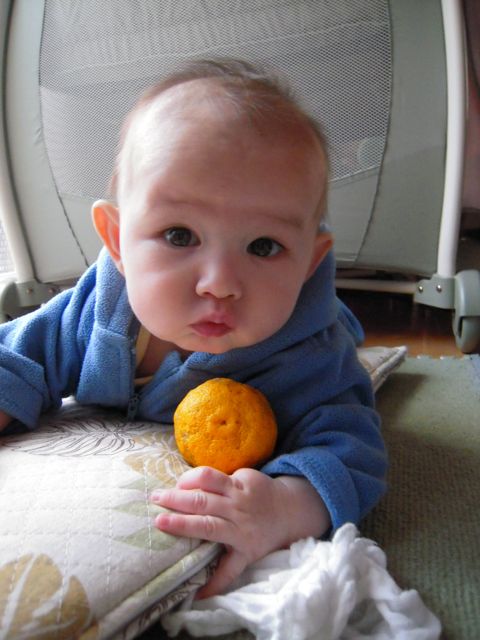
The time has come to enjoy the new smells of the season.  As December arrives the smell of yuzu once again returns to brighten up the winter.  Little Lady had a chance to explore and play with a yuzu this week.  She smelled it, rolled it and licked it.  Even at 3 months old it was clear that she enjoyed being able to learn about yuzu in her own way.
Soon she'll get to learn about apples!

Friday, June 18, 2010

More Puzzles

My little helper was at it again... I opened the closet door to find something and he dove right in to find a thing or two himself!
When we went to the US last summer I picked up the Infantino Matching Colors and Textures Puzzle. At 18 months old it was a great activity when used by category (color, texture, etc.) but what a difference a year makes! Now the Little Guy can take on the whole pile of pieces at one time!
The other big change is that last summer he used signs to tell me what most of the pictures were but now he does the puzzle with a running dialogue complete with his own ideas of what various things are/could be.

We also have the Where's my Tail puzzle. Again, it was a challenge at 18 months and it is easy now at 2.5 years old. I really love the Infantio puzzles and if we were headed to the US again this year I would pick up a few more. They are durable, age appropriate and have great artwork!

Tuesday, May 4, 2010

Shape Matching

One of the fun parts of moving is rediscovering old activities. Here is one that we picked up last summer when the Little Guy was too little to really enjoy it. I knew that some day he would understand what to do and it seems that the day has come!
This is the 3D Feel and Find from Guide Craft. エド・インターに似ているの物あります。
The set comes with durable, wooden pieces which each have a matching plate with a cut-out of the shape.
Here you can see the Little Guy reaching into the bag to take out a piece.
He then matches the piece to the plate on the table. To add a little more challenge we then worked together to separate the pieces into living and non-living categories. In the Little Guys's mind it was "shapes" and "zoo things" since you can see animals, trees and people at the zoo.
When he finished sorting the stacking blocks came out. Hmm... what's up?
Aparently after sorting the shapes they needed to disappear! In my mind that would include putting them bag in the bag and into the closet. In his mind that meant covering them up!

Thursday, February 18, 2010

Snow Day

One of the joys of having a toddler is watching him explore the seasons and learn about all the unique forms of weather. This morning we were treated to afew inches of snow. The Little Guy was asking to go out before I was even awake! So, before breakfast we had a good hour of exploring the cold and snow.
Shake a tree, make it snow!

He really wanted to make a snow angel.


Nothing like topping off some play time with a bit of puddle jumping!

Friday, October 30, 2009

Leaf Matching

I recently discovered a wonderful site called filefolderfun.com. While navagating the site can be a bit tricky due to all the advertising, it is possible to find some fun and easy to prepare activities. The whole concept is that the games and activities are played on a file folder so they are easy to store and take along. I'm adapting them to the Japanese-style clear file and to a the level of my toddler.
Here we have a fall leaves color matching activity. I printed two copies of each of the page: page 1, page 2, page 3. One copy of each is as printed and the other copy has the leaves/helicopters cut out. Since I love to laminate the whole set got laminated.
With a 2 year old it is good to start with one leaf page and the 5 corresponding leaves. You can work your way up to all 10.
Another potential activity is matching the helicopters to the loose leaves by color.

Wednesday, October 21, 2009

Matching Caps

The little guy and I discovered a new activity today - matching pop bottle caps!
It started with practicing putting caps in the can which we haven't done in ages. When we took the caps out it seemed natural to line them up. We practiced counting and placed the caps in the can according to color.
While looking at the designs I noticed that we have a lot of pairs (and way too many Pepsi NEX caps!) so we tried lining them up. The truck was brought in the aid in the "delivery" of the caps to their "home"
It helps that our kotatsu has a grid which matches the cap size.
I also noticed that the newer caps tend to be white with simpler designs. Perhaps a reflection of the state of the economy?

Some of the caps were clearly different, They were different colors or had different designs. Others were harder to tell apart. The two green caps with faces pictured here were a bit of a challenge.
I think this is a good activity to encourage a child to look at the details of an object. Now that I've noticed the details I'll probably start shopping for drinks based on the cap designs! :-)

Friday, October 9, 2009

Teaching Colors

I've been looking forward to doing this activity for some time. The Montessori Color Tablets caught my attention right away when I was looking for activities to do at home. The ability to see color and differentiate shades of colors is a very special gift. Could you imagine a sunset in shades of gray? Or a theater production lit only with white lights? Color is such a huge part of our world!
Since I'm only working with one child and in a home enviroment buying all the nice sets for montessori activities is not an option for us. In this case we have opted for a well-known substitute for the color tablets - paint samples.
I have to admit here that I don't know where in Tokyo to get similar samples so I picked them up while in the US last summer. I'm sure they can be found here too - I just don't know where.
These are paint examples from a homestore that I laminated to make a bit more durable.

I started by introducing the red, yellow and blue colors first. The little guy grasped the idea so quickly that I didn't even get a picture of it!

This is the "basic" set that I made. It was too easy in that the little guy barely had to think to do it and lined up all the colors correctly on the first try. Next time I'll introduce shades of color to him.

Margaret Homfray showing how to use the color tablets:

Thursday, August 27, 2009

Casa Dei Bambini (Montessori)

http://www.casadeibambini.net/curriculum.html

In the Montessori classroom, the space is divided into several logical areas by low open shelves: one for practical Life exercises, one for Sensorial, one for Language, another for Math and other areas for art, music, geography and science.
The Montessori Curriculum is an integrated thematic approach that ties the separate disciplines together into studies of the physical universe, the world of nature, and the human experience. In this way, one lesson leads to many others.
Each material isolates one concept or skill that has been specially designed in a way that children are naturally drawn to want to work with it with little or no nudging from adults. Each material has also been designed so that a child can normally check his own work; we cal this a built-in "control of error." The intention of the materials is not to keep the children dependent on these artificial learning aids forever; they are used as tools to help children work and learn at their own pace, to see abstract ideas presented in a very concrete, three-dimensional way, and to help them grasp and understand what they are working on.
Montessori students learn not to be afraid of making mistakes. They quickly find that few things in life come easily, and they can try again without fear of embarrassment.

Practical Life
This area of the curriculum is designed to invite the young learner to act and work on real life tasks that foster independence, coordination, order and concentration. It is in a sense the doorway to the Montessori curriculum. This is the area where the child may first choose independent work. The practical life area contains many attractively displayed object familiar to the child, including a variety of items commonly used in the tasks of daily living, like eating dressing and cleaning.
They offer the child meaningful, non-threatening modes of activity. The materials are also carefully designed and demonstrated to help teach skills involved with caring for the environment and the self, to encourage responsibility, autonomy and to promote high self-esteem.

Sensorial
Dr. Montessori saw the senses as the "doorway to the mind." She considered sensory and manipulation not only an aid to the development of maturing sense organs (eyes, ears, nose, tongue and skin) but a starting point for the intellectual growth. she believed that by helping children to order, compare and classify sensory stimulation, their intellectual development would be greatly assisted and future learning would be more meaningful and useful. The basic sensorial exercise inspires careful observation and calls attention to specific qualities requiring identification of similarities and contrasts. The mind must judge, compare, classify and draw conclusions. These exercises tend to fascinate children because they are difficult enough to represent a real and meaningful challenge. They are then better prepared for future learning in math, language, and science and making sense of life's experiences and information in general.

Mathematics
The central purpose of the Math materials in the early years is to lay the foundation for later cognitive development and to prepare for the gradual transition to abstract thinking. The primary value of these earlier activities in mathematics are found in the way they transform ideas into actions on concrete materials. Students who learn math by rote method often have not real understanding or ability to put their skills to use in everyday life. Montessori students use hands-on learning materials that make abstract concepts clear and concrete.
The Montessori math curriculum is based on the European tradition of "Unified Math," which has only recently been recognized by leading American educators. Unified Math introduces elementary students to the study of the fundamentals of algebra, geometry, logic and statistics along with the principle of arithmetic. This study continues over the years, weaving together subjects that traditional schools normally ignore until the secondary grades.

Language
Language development is a concern of the entire Montessori classroom. Many activities in other areas, as well as with a large group, foster vocabulary development, communication skills, writing and reading readiness.
In the language area we will find a large variety of reading readiness materials, including materials for phonetic analysis, word attack skills and reading, as well as materials for the refinement of motor control for writing.
In the Montessori Method, writing precedes reading, as the children explore with drawing and forming letters. The process of learning how to read should be as painless and simple as learning how to speak. The child begins by exploring the sounds that compose words and by relating them to the letters of the alphabet. He can soon produce words and sentences free of all other mechanical difficulties. In the meantime he trains his hand to become precise and sure for the writing movements. Reading is prepared indirectly from writing. The child starts from what he knows about the letters and the sounds.
Then we give him the key to read all the words he can encounter. Reading skills normally develop so smoothly in Montessori classrooms that students tend to exhibit a sudden "reading explosion" which leaves the children and their families beaming with pride.
Dr. Montessori's research confirmed what observant parents have always known: children learn best by touch and manipulation, not by repeating what they are told. Her manipulative approach to teaching children how to read phonetically is nothing short of brilliance and should have long ago become a basic element on every Early-childhood classroom around the world.

Science, Geography, the Arts and Other Areas of the Montessori Curriculum
Science is an integral element of the Montessori curriculum. Among other things, it represents a way of life: a clear thinking approach to gathering information and problem solving. The scope of the Montessori science curriculum includes a sound introduction to botany, zoology, chemistry, physics, geology and astronomy. The Montessori approach to science cultivates children's fascination with the universe and helps them develop a lifelong interest in observing nature and discovering more about the world in which we live.
Our teachers introduce history and geography as early as age three. The youngest students work with specially designed maps and begin to learn the names of the world's continents and countries. Later in elementary school the students see the world's cultures in greater depth. They learn to treasure the richness of their own cultural heritage and those of their friends.
Music and movement education will also be important parts of the curriculum as well as the Arts. They offer children ways to express themselves, their feelings, experiences and ideas. Montessori schools are very interested in helping children develop control of their fine and gross-motor movement.

Wednesday, August 26, 2009

Water Play


Here is an activity that we did.
The objective was simple: get the little guy to stop bugging me!
He was having a hard time on a cold and rainy Monday finding anything that could hold his attention. He's had another brain spurt - it's like a developmental growth spurt. Suddenly all the "old" activities are too easy of no longer hold a challenge. After a morning of trying different things I parked him at the sink with some water. Thankfully he was enthralled!

Signs: yummy, Daddy, water, bye